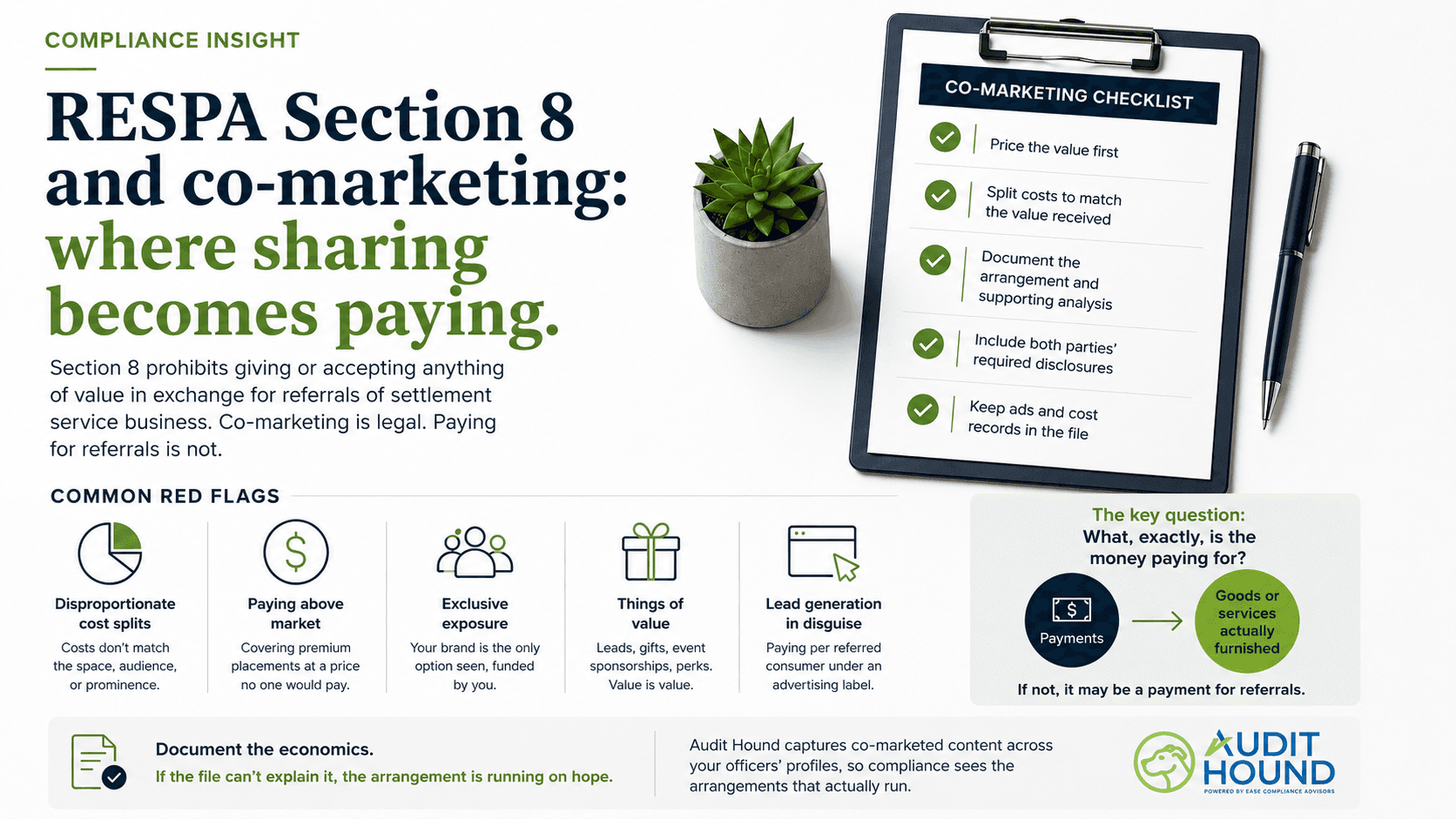
Co-marketing with a real estate agent is legal. Paying for referrals is not. RESPA Section 8 (12 U.S.C. 2607) prohibits giving or accepting any thing of value in exchange for referrals of settlement service business, and the entire discipline of compliant co-marketing is keeping those two sentences from touching. The question to ask about any arrangement is always the same: what, exactly, is the money paying for?
The safe harbor and its condition
Section 8 permits payments for goods actually furnished and services actually performed, at their reasonable value. A shared Facebook ad where the officer pays half the cost and receives half the advertising space is a payment for advertising. The same ad where the officer pays 80 percent for a logo in the corner is, in substance, paying 30 points of someone else's marketing in exchange for the relationship, and the label "co-marketing" will not save it.
Where digital arrangements go wrong
- Disproportionate splits: cost shares that do not track the space, audience, or prominence each party receives.
- Paying above market: covering an agent's premium placement on a listing portal at a price no one would pay for the exposure alone.
- The exclusive feed: an officer as the only lender an agent's audience ever sees, bankrolled by the officer, with no honest advertising value analysis anywhere.
- Things of value in kind: leads, event sponsorships, "marketing sessions," gift baskets tied to closings. Value is value; Section 8 does not require cash.
- The lead-generation wrapper: paying a platform per referred consumer under an advertising label. Structure matters, and regulators read through labels.
What to document
Compliant co-marketing leaves a file: the arrangement in writing, the cost split, the basis for concluding each party paid fair value for what it received, and the creative itself with both parties' required disclosures (the officer's licensing elements do not disappear because an agent shares the ad). If the file cannot explain the economics, the arrangement is running on hope.
What good practice looks like
- Price the value first, split costs to match, and write the analysis down.
- Re-verify long-running arrangements; audiences and placements drift.
- Keep every co-marketed ad in the marketing file with its cost records.
- Treat anything of value flowing toward a referral source as a Section 8 question.
Audit Hound captures co-marketed content across your officers' profiles, so compliance sees the arrangements that actually run, not just the ones that were approved.
This article is compliance reference material, not legal advice. Rules change and states differ; confirm requirements for your licenses with your compliance advisor or counsel.