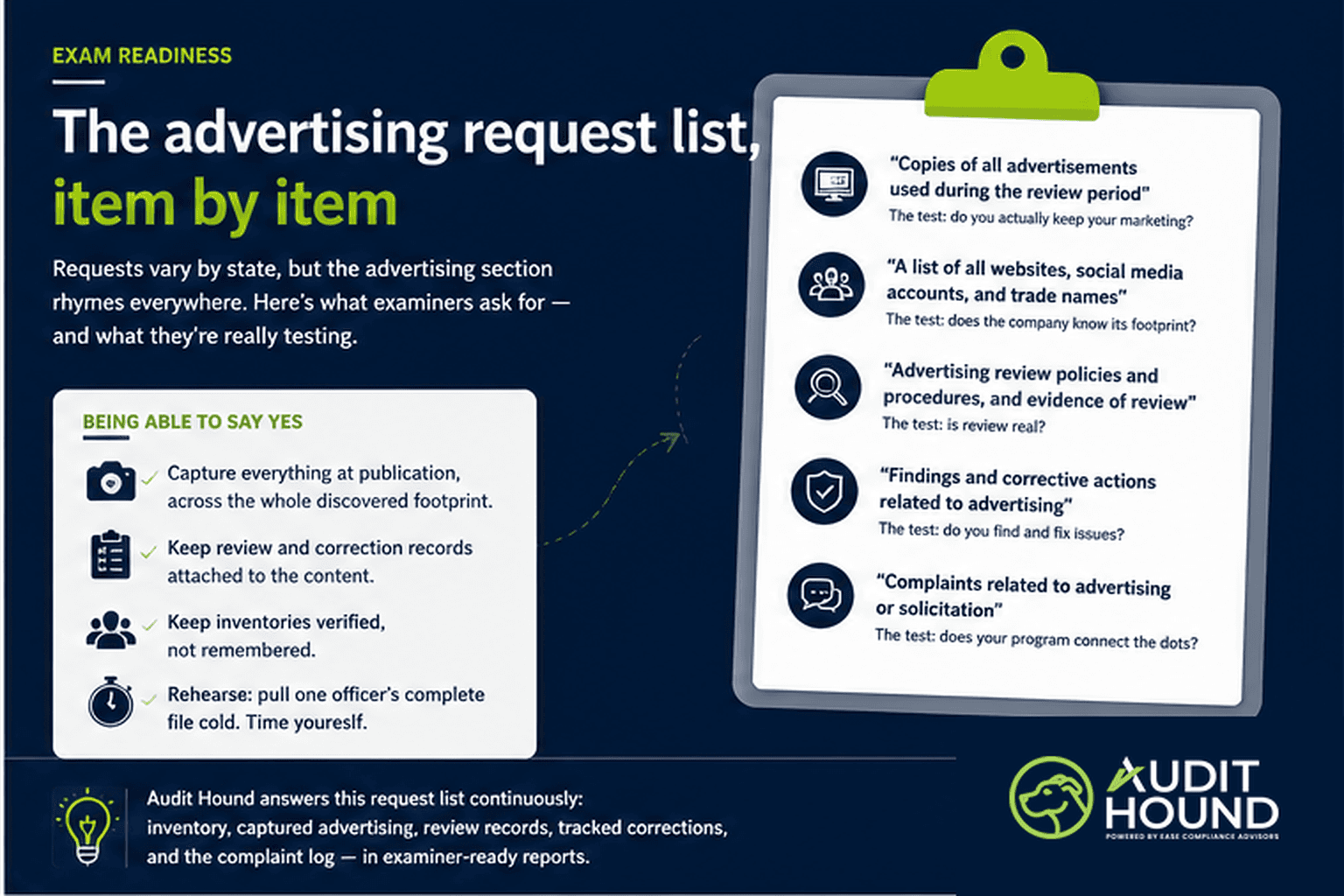
Exam request lists vary by state, but the advertising section rhymes everywhere. Here are the requests our advisors see over and over, and, more usefully, what each one is actually testing. An exam is a series of questions about whether your program exists; every item below is answerable in an afternoon if it does, and in no amount of time if it does not.
"Copies of all advertisements used during the review period"
The foundation request, and it usually says all media and often names social media and websites explicitly. The test: do you actually keep your marketing? Reconstructions are obvious, and screenshots taken last week of ads that ran last year prove the absence of a program. The answer is capture at publication time, preserved as run.
"A list of all websites, social media accounts, and trade names"
The inventory request. The test: does the company know its own footprint? The dangerous version of this answer is the one missing accounts the examiner then finds by searching. Your inventory has to be discovered from the wild, not compiled from memory.
"Advertising review policies and procedures, and evidence of review"
The program request. The test: is review real? A policy PDF with no evidence of execution reads worse than no policy. Evidence means review records tied to specific ads: what was checked, what was found, when, by whom.
"Findings and corrective actions related to advertising"
The self-awareness request. Companies fear this one backwards: a clean sheet ("we have never found anything") signals a program that does not look, while a tracked record of findings corrected on dates tells the examiner your program works. Show the loop: found, notified, fixed, verified.
"Complaints related to advertising or solicitation"
The intersection request. The test: does your complaint program talk to your marketing program? Marketing-tagged complaint entries, read beside the ads they concern, answer it.
Being able to say yes
- Capture everything at publication, across the whole discovered footprint.
- Keep review and correction records attached to the content they concern.
- Keep the trade name and account inventories verified, not remembered.
- Rehearse: pull one officer's complete file cold. Time yourself.
Audit Hound is, in effect, this request list answered continuously: discovered inventory, captured advertising, review records, tracked corrections, and the complaint log, assembled into examiner-ready reports on demand.
This article is compliance reference material, not legal advice. Rules change and states differ; confirm requirements for your licenses with your compliance advisor or counsel.