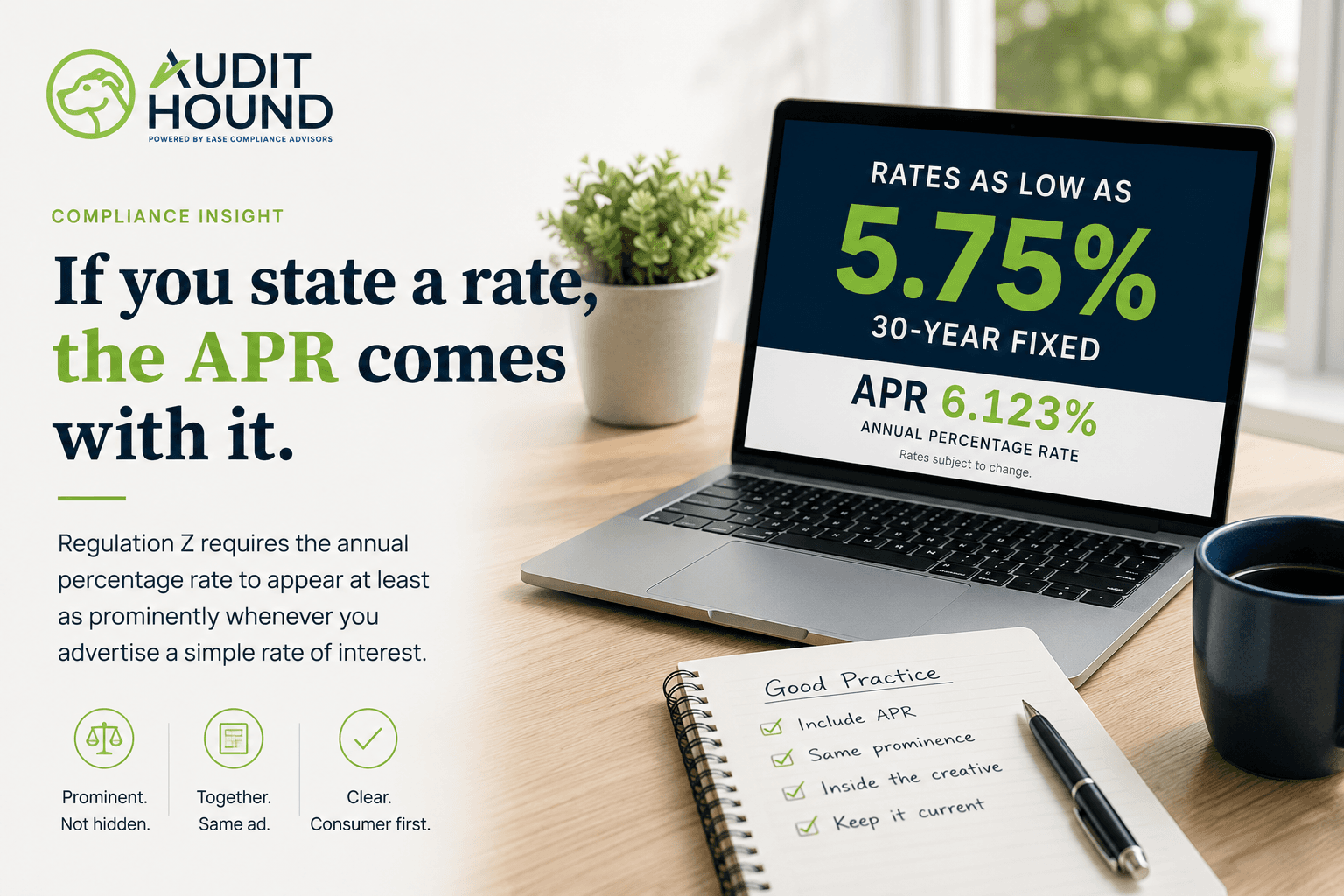
The rule is one sentence long and violated every day: if an advertisement for closed-end credit states a simple rate of interest, Regulation Z (12 CFR 1026.24(c)) requires the annual percentage rate to appear too, at least as prominently, using the term "annual percentage rate" or "APR." A bold 5.75 with a whispered APR is not compliance. A bold 5.75 with no APR at all is the most common advertising finding we confirm.
Why the rule exists
A note rate and an APR answer different questions. The note rate prices the loan; the APR prices the loan plus its costs, which is what lets a consumer compare two offers honestly. An ad that shows only the prettier number invites a comparison the consumer cannot actually make. That is why the regulation insists both numbers travel together, with equal billing.
What "at least as prominently" means in practice
- Equal or larger type size. The APR cannot live in the footnote while the rate headlines.
- Inside the same creative. A rate in the image with the APR in the caption fails the moment the image is shared alone, and images are always shared alone.
- Spoken as well as shown. In video, a spoken rate calls for the APR in the same breath or on screen with real prominence, not flashed for a frame.
The mistakes that generate findings
- The rate graphic: a flyer built around one big number, disclosures nowhere in the pixels.
- The dated rate: a compliant ad left up for months after rates moved. An available-rate claim has to be true when a consumer reads it, not when it was posted.
- The comment-section quote: an officer replying "we can do 5.99" under a post. Replies are advertising, and a stated rate in a reply triggers the same obligations.
- The teaser without the story: promotional rates that do not explain what happens after the promotional period, which raises misleading-advertising problems on top of the prominence rule.
What good practice looks like
- Treat any specific number as a build-the-disclosure-in requirement, inside the creative.
- Date-stamp rate content and take it down on a schedule, not on memory.
- Review video by transcript and frame, since rates arrive by voice and by overlay.
- Watch the comments: officers quote rates in replies more often than in posts.
Audit Hound reads every post, image, video transcript, and reply for stated rates and checks the APR treatment against Regulation Z, and an EASE advisor confirms each finding before it reaches your team.
This article is compliance reference material, not legal advice. Rules change and states differ; confirm requirements for your licenses with your compliance advisor or counsel.