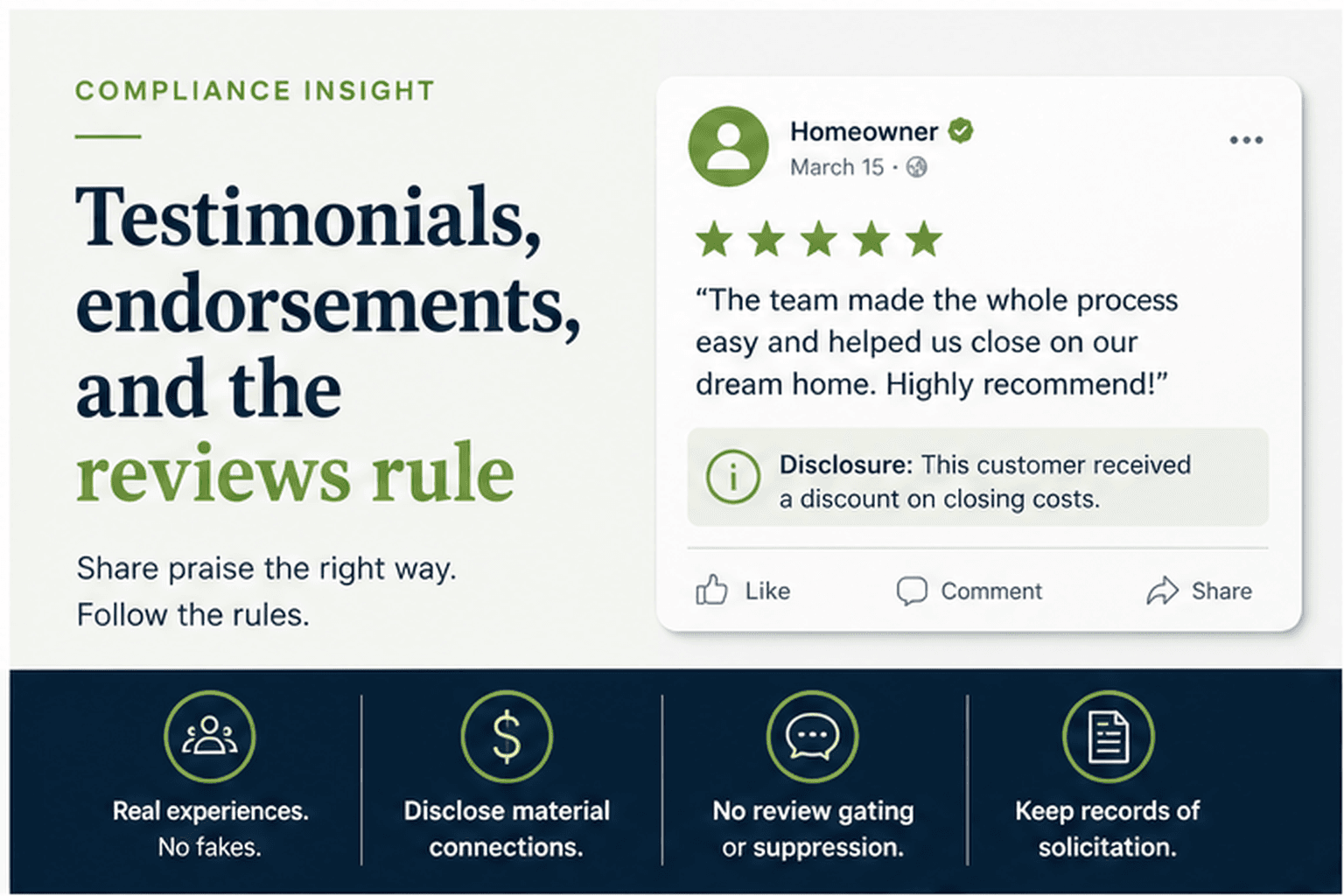
Reposting a happy client's message is an endorsement. Paying a local influencer to mention your team is an endorsement. Both are regulated, and since late 2024 the rules around reviews specifically carry civil penalties. Testimonials are the most natural content an officer can share and the least understood category in the rulebook.
The endorsement guides: disclosure and truth
The FTC's Endorsement Guides (16 CFR Part 255) set two baseline duties. The endorsement must reflect the honest experience of a real person, and any material connection between the endorser and the company must be clearly disclosed. Material connections include payment, free services, discounts, and employment: an officer's spouse praising the company, or a paid influencer post without a disclosure, both fail. The disclosure has to be hard to miss, in the same place as the endorsement, not buried behind a "more" link.
The Consumer Reviews Rule: the 2024 change
The FTC's Rule on Consumer Reviews and Testimonials (16 CFR Part 465, effective October 2024) turned several common practices into violations with civil penalties, which the FTC has stated can reach $51,744 per violation:
- Buying, selling, or procuring fake reviews, including AI-generated ones.
- Buying positive or negative reviews: compensation conditioned on the sentiment of the review.
- Review suppression: threats to get reviews removed, or presenting a curated subset as all reviews.
- Undisclosed insider reviews from officers, employees, or their relatives.
The practical trap for mortgage teams is review gating: asking satisfied clients for a public review while routing unhappy ones to a private form. Presenting the resulting one-sided picture as your reviews is exactly what the rule targets.
The mortgage-specific layer
A testimonial that mentions terms ("got us 5.5 when everyone quoted 6") imports the advertising rules into the review: a stated rate in a shared testimonial raises the same Regulation Z questions as a stated rate anywhere else. And a testimonial about approval speed or certainty can become a misleading claim when the company amplifies it as typical.
What good practice looks like
- Ask every client for feedback, not just the happy ones, and never condition anything on sentiment.
- Disclose material connections in the post itself, every time.
- Review testimonials before amplifying them; sharing is adopting.
- Keep records of solicitation practices; the rule reaches process, not just posts.
Audit Hound reviews shared testimonials and endorsements as the advertising they are, tracks your officers' review pages, and flags the patterns that the reviews rule now penalizes.
This article is compliance reference material, not legal advice. Rules change and states differ; confirm requirements for your licenses with your compliance advisor or counsel.