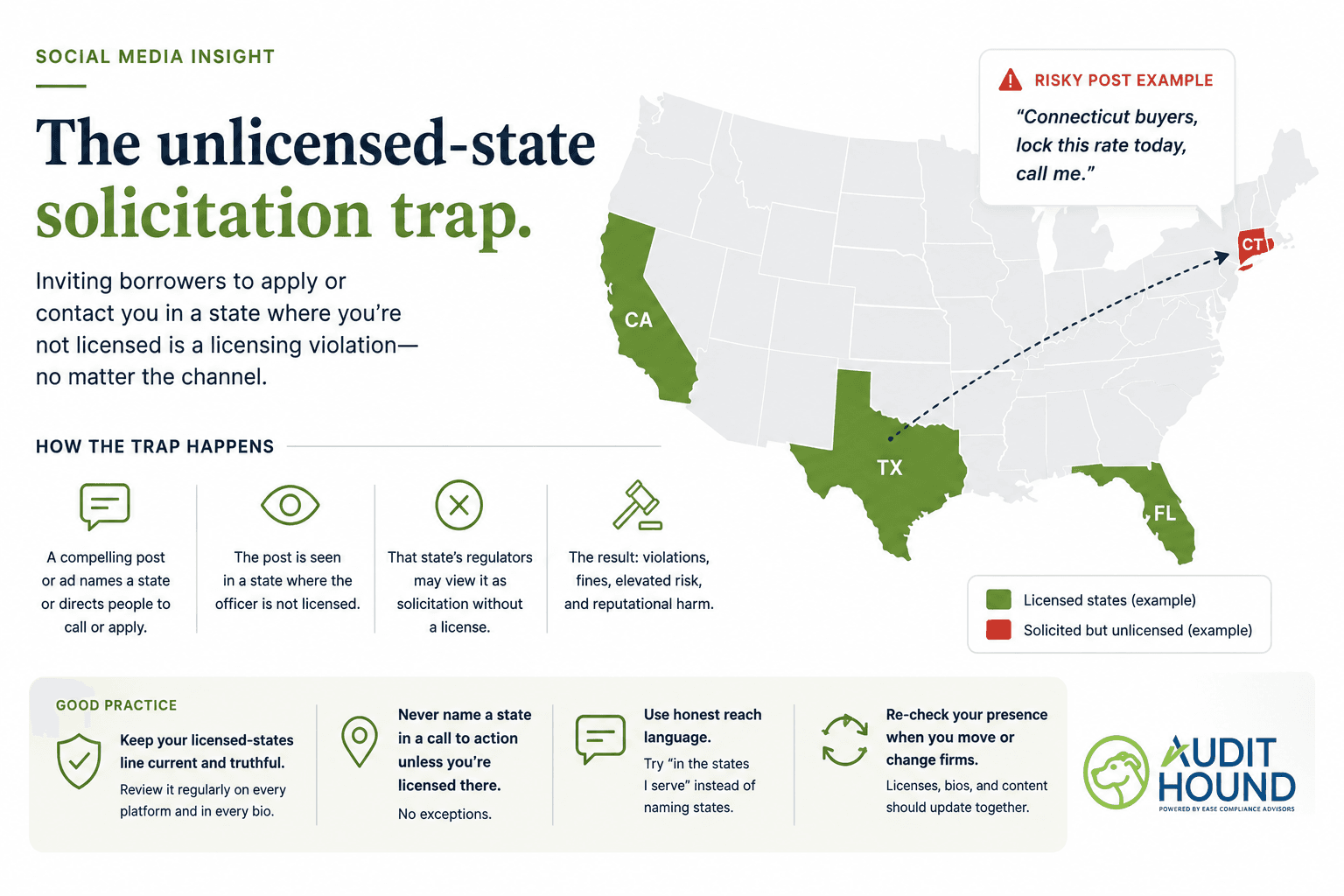
A loan officer licensed in California and Washington posts "Connecticut buyers: lock this rate today, call me." That post is a solicitation of Connecticut consumers by someone not licensed to originate there, and it is one of the cleanest findings a state regulator can write. Social platforms hand every officer a national audience; the license footprint stays exactly the size it is.
How the trap springs
- The named state: posts that address a specific state's consumers directly. Naming a state you are not licensed in, with a call to action, is the textbook version.
- The relocation friend: "moving to Texas? I can help!" when nobody on the license list can help in Texas.
- The stale bio: "serving all 50 states" boilerplate copied from a lead-gen template, or a company-wide claim pasted onto an individual officer's profile.
- The move that outran the licenses: an officer relocates and keeps marketing to the old audience while the new state's license is still pending.
What is generally safe
Generic content with national reach is not automatically solicitation everywhere. The analysis regulators apply is about targeting and invitation: whom does the post address, and what does it ask them to do? An education post about how escrow works reads differently from "DM me for a preapproval tonight" aimed at a named market. The licensed-states line in the profile should make the footprint honest, and the calls to action should stay inside it.
What good practice looks like
- Keep a current licensed-states line on every officer profile, and keep it truthful.
- Never name a state in a call to action unless the officer is licensed there.
- Rewrite reach-y templates: "in the states I serve" beats a list you cannot back.
- Re-check the whole presence when an officer moves companies or states; old claims linger in bios and pinned posts.
Audit Hound checks every post and profile against the officer's actual license footprint from NMLS, so a Connecticut call to action from a two-state officer surfaces as a finding before an examiner finds it first.
This article is compliance reference material, not legal advice. Rules change and states differ; confirm requirements for your licenses with your compliance advisor or counsel.